November 2026
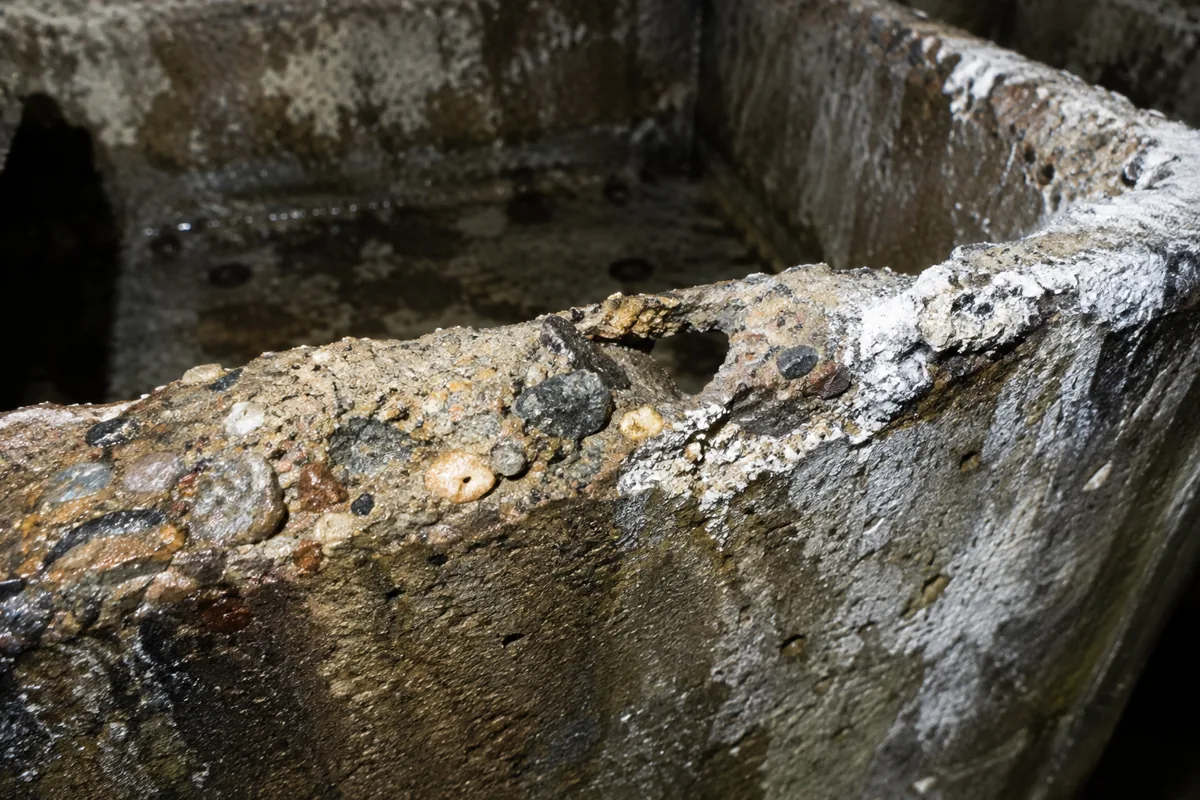
Most grease trap corrosion is caused by a gas, not by the grease. Bacteria in the waste make hydrogen sulfide, the gas moves into the air space at the top of the trap, and on the damp concrete there other bacteria turn it into sulfuric acid. That acid softens the walls and the baffle walls from the waterline up. A protective coating, epoxy or another kind, puts a barrier between the acid and the concrete or steel. It only holds on walls that are sound, clean and properly prepared, and it is no substitute for a structure that has already failed.
What causes grease trap corrosion?
EPA laid out the chain in its 1991 report to Congress on hydrogen sulfide corrosion. The report is about concrete sewers and never mentions grease traps, so applying it to a trap is our reading. A trap holds the same ingredients: wastewater that sits, an air space above it and concrete walls.
- Bacteria in the slime on surfaces under the water turn sulfate into sulfide.
- The sulfide becomes hydrogen sulfide (H2S), a gas dissolved in the water. It escapes into the air faster when the water is warmer, and much faster when the water is churned.
- On moist surfaces that sit above the water, a second group of bacteria turns the gas into sulfuric acid.
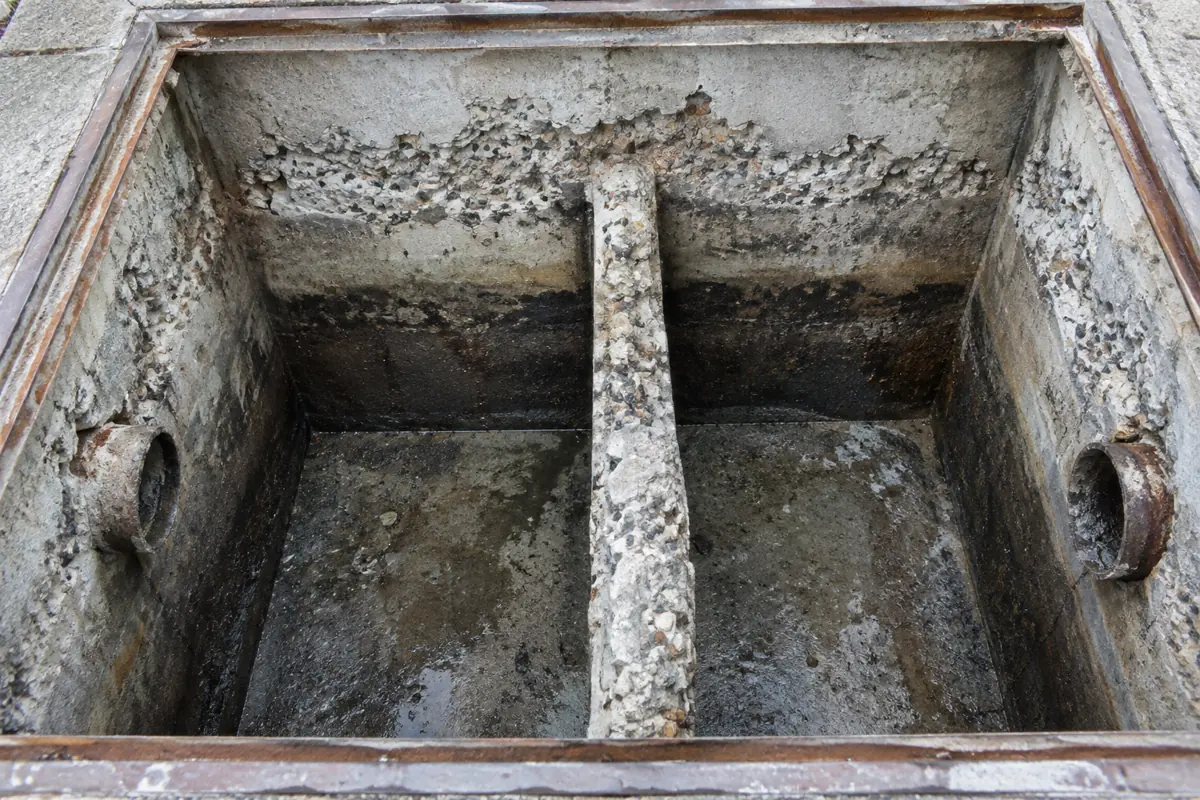
- The acid reacts with the cement and limestone in concrete and leaves soft products such as gypsum. In EPA’s words, “These products are washed away or fall out of the concrete matrix, exposing fresh concrete and aggregate to corrosion processes.” The attack keeps reaching new concrete.
Grease plays a smaller part: EPA notes that it carries weak acids that can add to corrosion, and lists high grease content among the waste traits to control. Steel has a second problem: hydrogen sulfide gas attacks iron and steel directly, with no acid step needed.
Time feeds all of it. EPA ties long detention, meaning wastewater left standing, to more sulfide, and a trap long past its pump-out date fits that description, in our reading. Hot, fast-moving discharge from a dish line likely releases more gas too; that is also our inference, not EPA’s statement.
Why is the damage worst above the waterline?
People expect the bottom of the trap to wear first. Sulfide is made under the water, but the acid forms on the wet surfaces above it, so concrete is lost in the band between the water surface and the lid.
EPA’s report treats acid found on the upper walls of a pipe as probably the most useful early warning of corrosion, and says many utilities only learn of corrosion when something collapses.
If your pumping company has told you the walls or the baffle look soft, crumbling or holed, call us at (833) 454-6464.
How the acid zone reaches the baffle wall
A baffle wall is the partition inside the tank that holds floating grease back while water passes under or through it to the outlet. Its upper part stands in the same acidic air as the outer walls. Unlike an outer wall, it has that air on both faces. That is our reading of the chemistry, not an EPA finding about baffles.
A baffle holds grease back because grease floats and will not go under it (see the Bellevue sheet in Sources). When a baffle corrodes through or breaks, that stops working: in our reading, grease can then ride through to the outlet and heads for the sewer line.
The pipe fittings matter as much. The presenter in EPA’s grease webinar for operators calls the outlet tee, the T-shaped pipe that draws water from below the grease layer, “critical”. On a steel trap, the gas attacks the metal directly.
For the basics of what a baffle wall does and how a broken one shows up, see our sister site’s guide.
What a grease trap baffle wall does, and why it breaks
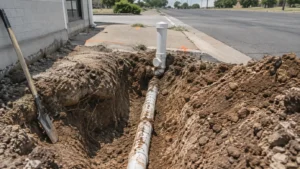
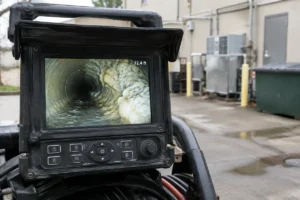
In our reading, grease that gets past a failed baffle goes on into the building’s sewer line, where it can build up and block the pipe. A camera run down the line shows how far it has gone.
Grease buildup in a commercial sewer line
Signs a commercial sewer line is failing
Do steel and fiberglass grease traps corrode?
EPA’s grease webinar lists four interceptor materials, concrete, fiberglass, plastic and steel, without ranking them:
- Concrete loses cement and stone to the acid, as above.
- Steel is attacked by the gas directly, as well as by the acid.
- Fiberglass and plastic come out better in the sources we read, though none of them is about traps: EPA calls PVC and clay pipe immune to hydrogen sulfide corrosion. No official source we read says a fiberglass trap can never fail, and San Antonio Water System’s spec for fiberglass manholes (Item 853) ties long corrosion-resistant service to correct handling and installation.
We repair cast concrete, steel and fiberglass traps of all sizes, underground or above ground.
What does an epoxy coating do for a grease trap?
A coating is a barrier. EPA describes corrosion repair as doing two jobs: protecting the structure’s strength and adding “a protective barrier against subsequent acid attack”. The coat does the second job: it keeps acid off the concrete or steel. It does not make a thin or broken wall strong again; that takes repair work first.
“Epoxy” is one family among several. Austin Water’s approved list for lining wastewater manholes (WW-511) says the material shall be urethane, polyurethane, epoxy or polyurea. San Antonio Water System’s manhole spec has existing manholes get a cement-based coat first and then an approved epoxy, with one thick cement-based product as the exception. So “epoxy coating” on a quote tells you the family, not the product. Ask which product it is and ask for its data sheet.
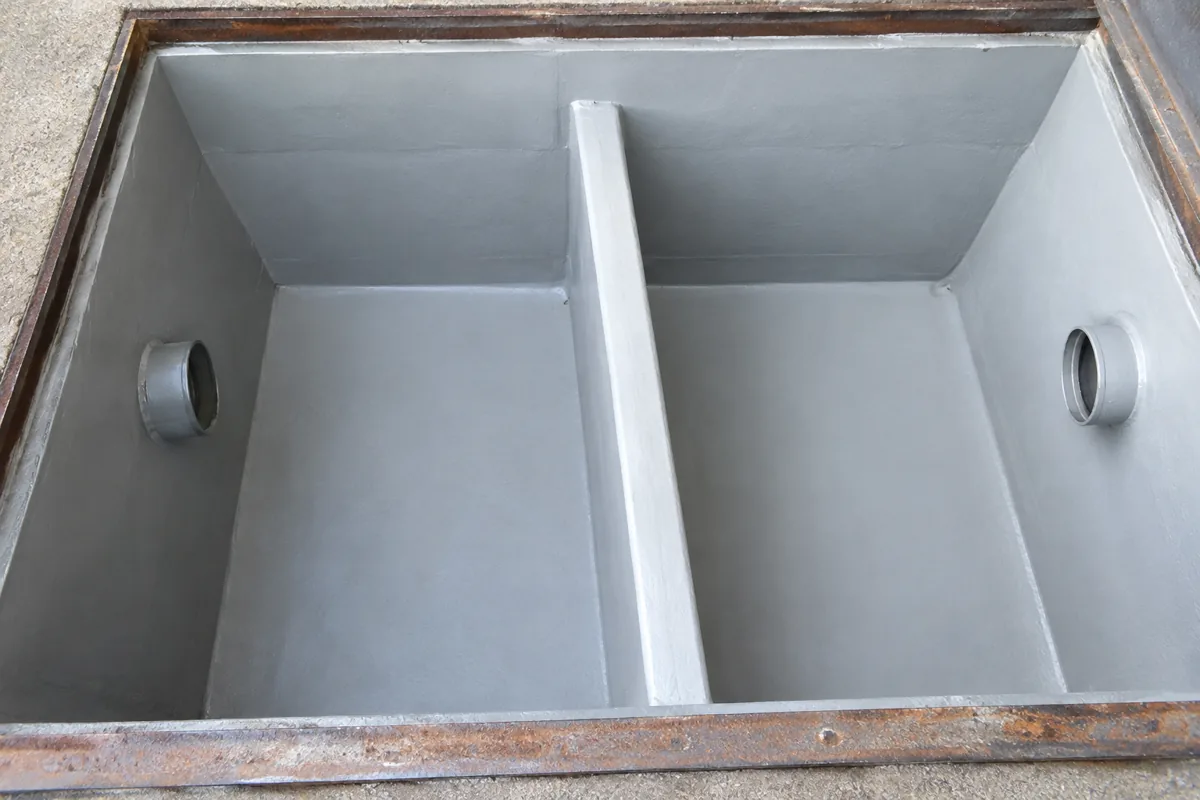
Our grease trap repair follows that order. We clean and degrease the trap, repair every hole and crack, rebuild broken walls, including baffle walls, and then coat the whole trap. Our repair materials are certified to NSF/ANSI 14 and 61.
The same acid attacks concrete manholes, and coating them works on the same principle.
Why surface preparation decides whether the coating holds
A coat is only as good as the surface under it. EPA’s 1991 comparison of sewer repair methods says coatings need more surface preparation than other methods and puts it bluntly: “Imperfect installations fail completely.”
The clearest Texas text on preparing concrete in wastewater for a coat is the San Antonio Water System spec for manhole rehabilitation (Item 910). It is written for manholes, not traps, but its steps show what careful work looks like:
- “Concrete that is not sound or has been damaged by chemical exposure shall be removed to a sound, concrete surface.”
- All oils, grease and other contaminants come off.
- The surface is cleaned and roughened so the coat has enough grip and pores to bond to.
- Detergent or acid cleaning is used where grease and oil are present. That is a contractor step, never a do-it-yourself one.
- Active water leaks are stopped before coating.
- The concrete is tested for pH or moisture when the coating maker requires it.
In our reading, a grease trap is a hard surface to coat, because grease is soaked into concrete that the acid may already have softened. That is why the degreasing and the cutting back to sound material come before any coat.
Why cure time and checking the coat matter
A coating needs time to cure before it carries wastewater again, and that time belongs to the product. Austin Water’s manhole lining list (WW-511) says surface preparation, application and curing must follow the maker’s written recommendations, the product technical data sheet. No general rule sets one cure time for every coating. Ask for the data sheet’s figure.
The San Antonio spec also shows how good work is checked:
- “The liner material must be applied by a Certified Applicator of the liner manufacturer.”
- The coat goes on to a minimum thickness.
- “Every manhole that is rehabilitated shall be inspected using high-voltage holiday detection equipment.” A holiday is a pinhole or bare spot the coat missed. Each one found is roughened and recoated.
- Every manhole also gets a leak test.
Questions worth asking any contractor who offers to coat your trap: which product, what the data sheet says about cure time and thickness, and how the finished coat is checked.
We do the repair overnight, after you close.
What does NSF/ANSI 14 and 61 certification mean?
NSF/ANSI 61 is a drinking-water standard. Texas uses it in its public drinking water rules: 30 TAC 290.44(a)(1) says “All newly installed pipes and related products must conform to American National Standards Institute/NSF International (ANSI/NSF) Standard 61 and must be certified by an organization accredited by ANSI.” It is about what a material may release into water people drink.
What it does not mean:
- It is not a test of how well a coating resists sulfuric acid or grease. In our reading, it says nothing about how long a coating lasts in a grease trap.
- It is not an approval of a contractor. NSF/ANSI 61 is about materials and products, not the crew that puts them on.
- No Texas grease trap or wastewater rule we reviewed requires NSF/ANSI 61.
NSF/ANSI 14 is a separate standard. We could not read its scope text from the standards body, so we don’t describe it here. If a contractor names either standard, ask which product carries it, and for the paperwork that shows it.
What shortens a coating’s life?
- Skipped pump-outs. Waste that sits longer gives bacteria more time to make the gas (our reading of EPA’s sewer findings).
- Poor preparation or missed spots. EPA warns that imperfect coating installations fail completely, and San Antonio’s spec has every pinhole found, roughened and recoated.
- The wrong product. In 1991 EPA found that most coatings then in use did not resist acid for long, and that some sold as “corrosion-resistant” failed early. Products have changed since, but it is a reason to ask what a product is made to resist.
Regular pump-outs are your pumping company’s job; we don’t pump traps.
When is a coating not enough?
A barrier assumes a sound structure behind it. EPA’s 1991 table of sewer repair methods says non-structural liners “should be used only in structurally sound sewers”, and calls replacement the most costly and disruptive method, kept for major structural defects. That is written about pipes, but the principle carries over to a trap.
So the question is whether the trap can be made sound first. Holes, cracks and broken walls, baffle walls included, are repaired before the coat goes on. A trap whose structure has failed beyond repair needs replacing; a coat would only hide the problem.
A coating is also not the answer when:
- The trap is just full. That is a pump-out, not damage. Call your pumping company.
- The trap is too small for the kitchen. EPA notes that an undersized trap lets grease short-circuit to the sewer, and a coating doesn’t change the size.
Can you check a trap for corrosion yourself?
No. Don’t open, lean into or enter a grease trap. OSHA says hydrogen sulfide is heavier than air and collects in low-lying and enclosed spaces such as manholes and sewers. After a while you can no longer smell it, so “no smell” does not mean safe air. At very high levels it can cause collapse within one or two breaths.
Ask your pumping company what they see on the walls and baffle while the trap is empty, keep any photos, and have the trap inspected.
Questions owners ask about coating a grease trap
How long does a grease trap coating last?
We found no independent study that gives a figure, so be wary of one quoted without a source. Our grease trap repairs carry a 10-year warranty on labor and materials, as long as the trap gets regular pump-outs. That warranty is our promise about our work, not a measured coating life.
Is a grease trap epoxy coating the same as epoxy pipe lining?
No. A trap coating protects the walls of a tank. In pipes, “epoxy lining” can mean a resin-filled liner or a sprayed coat, which our lining guide explains.
How long CIPP pipe lining lasts, and whether epoxy lining is the same
Can a corroded trap be repaired instead of replaced?
Often. Holes, cracks and broken walls, baffle walls included, can be rebuilt and coated with the rest of the trap. The free inspection shows whether repair or replacement fits your trap.
Sources
San Antonio Water System, Standard Specifications (2021), Item 853 Fiberglass Manholes
San Antonio Water System, Standard Specifications (2021), Item 910 Manhole Rehabilitation
Texas Administrative Code, 30 TAC 290.44, water distribution (Cornell LII copy, read November 2026)
City of Bellevue, Washington, Fats, Oils and Grease: How the System Works (undated sheet)
OSHA, Hydrogen sulfide (web page, read November 2026)
EPA, NPDES operator webinar: fats, oils and grease (October 2023 slides)
Talk to us about your trap
If a pumping company or an inspection has found soft walls, holes or a broken baffle wall in your restaurant’s or plant’s grease trap, call (833) 454-6464. We are open 24/7. You get a free on-site inspection by a technician, and a repair typically costs under half the cost of replacement.