Updated November 2026
A cured-in-place pipe (CIPP) liner is commonly designed around a 50-year service life. That figure is a design assumption, not a measured or guaranteed life: CIPP has only been in use since the early 1970s, and how long a given liner lasts depends on how it was designed, installed and checked. Epoxy lining is not always the same thing. “Epoxy” can mean the resin inside a CIPP liner, or a coating sprayed onto the pipe wall, and those are different methods.
What is CIPP pipe lining?
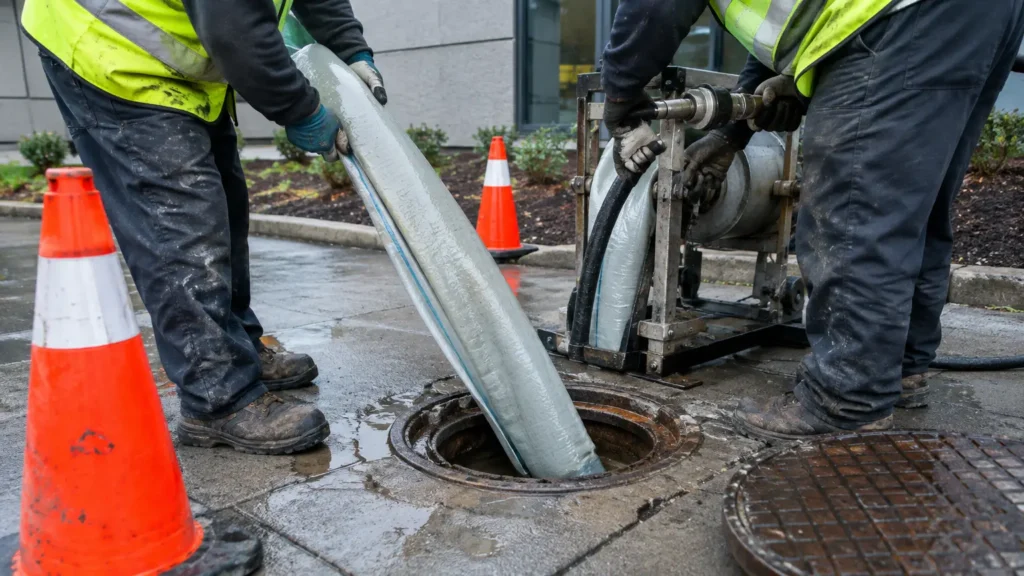
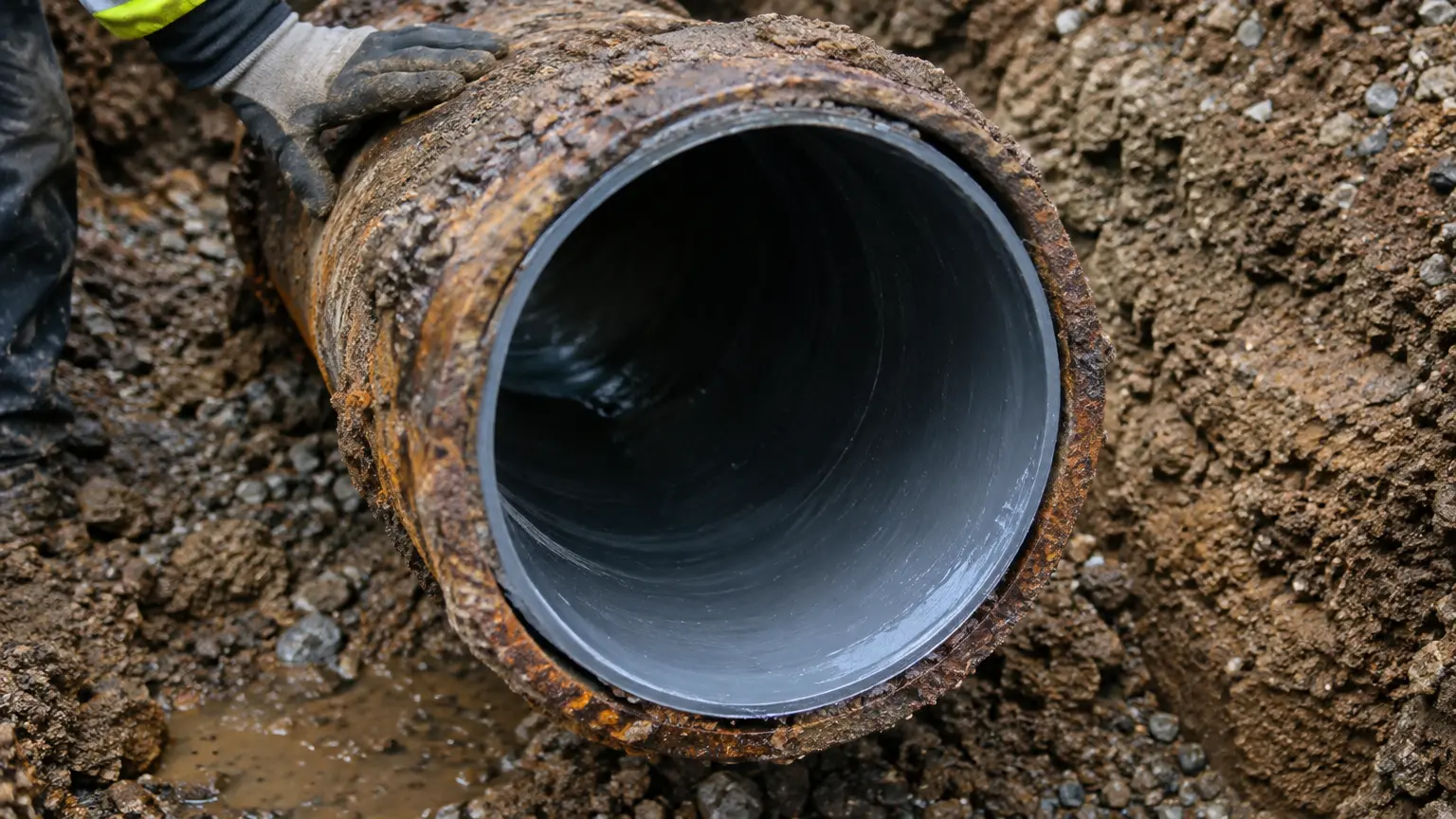
CIPP stands for cured-in-place pipe. A flexible fabric tube soaked in resin is put into the damaged pipe and then hardened (cured) where it sits. The result is a new pipe inside the old one.
The standards describe two ways to get the tube in. ASTM F1216 covers turning the tube inside out into the old pipe with water or air pressure, then curing it with hot water, steam or light. ASTM F1743 covers pulling the tube in and then inflating it. EPA’s 1999 trenchless fact sheet notes that the inside-out (inversion) method was the one more often used.
How long does CIPP lining last?
A liner is usually designed for 50 years. A column published by NASSCO, a sewer rehabilitation industry group, quotes its former technical director: 50 years was picked in the mid-1980s because it is a common government planning cycle, and the figure then spread into papers and advertising.
The column adds that design standards such as ASTM F1216 now give a tested method for sizing liner thickness, one that accounts for groundwater, the weight of the soil and traffic loads over the pipe. The chair of NASSCO’s technical advisory council still draws a clear line: a liner designed for 50 years is not guaranteed to last 50 years. Its real remaining life is an assumption that rests on the design standard, a qualified installer and quality control.
There is also little field record yet. The first CIPP went in during the early 1970s, so only now are liners old enough to test the 50-year figure.
The honest answer, then: a liner can be built to a 50-year design basis, but no one can tell you in advance how many years your particular line will get.
What decides how long a liner lasts?
- Design. Liner thickness sized to the groundwater, soil and traffic over the pipe.
- Installation. EPA’s list of the method’s limits includes that a defective installation may be difficult to fix afterwards, and that resin can pool at the bottom of the pipe.
- Resin. EPA names polyester, vinyl ester and epoxy as the common CIPP resins and says each resists wastewater chemicals differently.
- Checking the finished work. A camera run after lining is part of checking the finished liner; NASSCO’s inspection coding has codes just for liners.
- How the line is cleaned later. Tell anyone who cleans or clears the line that it is lined, so they choose tools that will not damage the liner.
What about a commercial kitchen’s hot water, grease and cleaning chemicals? We found no published standard or government study that measures their effect on liner life. Ask whoever lines your pipe which resin the liner uses and whether it suits what your line carries. Grease that gets past a failing trap ends up in that line, so keeping the trap itself sound matters too.
What is epoxy pipe lining, and is it the same as CIPP?
Not always. The word “epoxy” is used for two different things:
- The resin inside a CIPP liner. Epoxy is one of the resins EPA lists for CIPP. A fabric tube soaked in epoxy and cured in place is still a CIPP liner.
- A coating on the pipe wall. Spray-on epoxy goes onto the inside of the old pipe as a coat, with no fabric tube. EPA’s comparison of sewer repair methods lists spray-on linings (epoxy resin or cement mortar) apart from cured-in-place linings.
ASTM’s standard for epoxy barrier coating (F2831) describes it as a non-structural coating for metal pressure pipe, applied by blowing, spinning or hand spraying, mainly against corrosion. That standard does not cover every epoxy product sold for drains, but it shows the difference: a CIPP liner forms a new pipe, while a barrier coating protects the wall of the old one.
How long does epoxy pipe lining last?
If “epoxy lining” means a CIPP liner made with epoxy resin, everything above about design life applies: it is designed around a figure, not guaranteed to it. For a spray-on epoxy coating we found no standard design-life figure, so ask the installer what life they design for and what their warranty covers.
So when a quote says “epoxy lining”, ask whether it means a cured-in-place liner or a coating. Pipe InterTech lines pipes with CIPP. We do not offer spray-on epoxy pipe coating.
Does lining make the pipe smaller?
Yes. The liner sits inside the old pipe, so the opening gets smaller. EPA notes that this tends to reduce how much the pipe can carry, although the new inside surface may be smoother. EPA gives no single percentage. Before the work, ask what the finished inside diameter will be, especially on a line that already runs close to full.
What lining can and can’t fix
EPA lists cracks, offset joints and structurally weak sections among the defects CIPP can repair, and says the resin bonds to the old pipe for a tighter seal than most trenchless methods.
A liner follows the old pipe, though. It does not change the slope, so it will not fix a belly, a sagging stretch where water and waste sit. Rules outside Texas show how cautious some places are: Pinellas County, Florida only allows lining a whole lateral that has no sags or offset joints, and St. Paul, Minnesota says lining will not address a belly. Ask what rule applies where your building sits.
Signs a commercial sewer line is failing
Why a camera inspection matters before and after lining
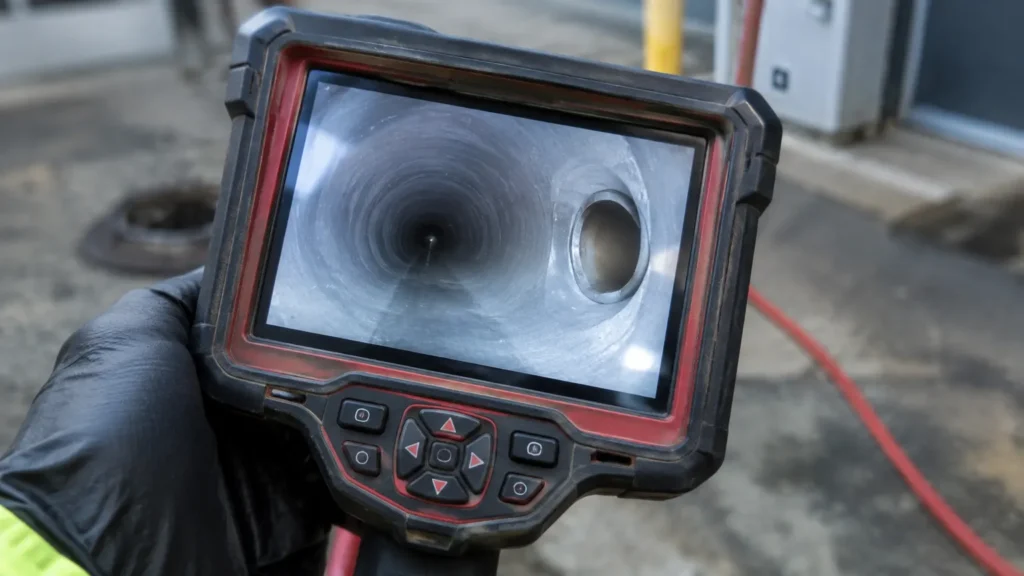
EPA describes cleaning and inspecting the line before and after it is rehabilitated, and says cleaning and inspection are typically required before lining. Before, the camera shows the pipe’s size, the damage and whether lining suits it. After, it checks the liner itself.
One thing the after-lining run looks for: when a liner expands, dimples form where side connections join the pipe. A camera or robot finds them, and a robotic cutter reopens those connections. NASSCO’s pipe inspection coding (PACP) has a group of codes just for checking liners. Keep the video from both runs: later checks of the line compare against them.
Warranty, pipe size, cleaning and who repairs the line
Does CIPP lining come with a warranty?
Lining work from Pipe InterTech carries a 1-year warranty. A design life is something else: the design-life figure discussed above is an assumption used across the CIPP industry, not a warranty term and not a promise about any particular liner.
What size pipes does Pipe InterTech line?
We line 3 to 8 inch pipes. The camera inspection shows whether lining suits your line.
Can a lined pipe be cleaned?
Yes, with care. Tell anyone who cleans or clears the line that it is lined, so they choose tools that will not damage the liner.
Is the sewer line under my building mine to repair?
It depends on the city. Our guide quotes the Dallas and Austin rules and says what to ask Houston.
Who is responsible for sewer line repair on a commercial property in Texas
Sources
ASTM F1216, standard practice for cured-in-place pipe by inversion (scope page)
NASSCO Tech Tips, October 2020 (the origin of the 50-year design life)
ASTM F1743, standard practice for pulled-in-place CIPP (scope page)
ASTM F2831, epoxy barrier coating for pressure pipe (scope page)
Pinellas County, Florida: accepted private sewer lateral lining
City of St. Paul, Minnesota: CIPP lining and belly acknowledgment form
Talk to us about your line
If a camera has shown cracks or a damaged section in the sewer line under your restaurant, property or plant, call (833) 454-6464. Calls are answered 24/7. We line 3 to 8 inch pipes, and the inspection shows whether lining fits your line.