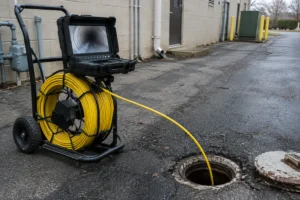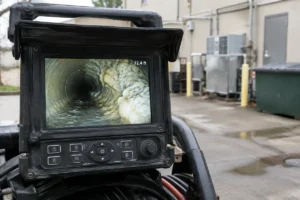
The signs of a failing commercial sewer line are backups that return soon after the line was cleared, floor drains that rise when the building is at its busiest, a sewer smell that keeps coming back, and grease turning up in the pipe after the grease trap. One clog is a cleaning job. The same problem again and again calls for a look inside: it can be damage, roots or grease buildup, and the first step is a camera inspection that shows what is wrong and where, before anyone digs or lines the pipe.
Sources checked November 1, 2026. Listed at the end of this post.
What are the signs of a failing commercial sewer line?
A line that breaks can back up all at once. Cracks, settling and roots work more slowly, so in a restaurant, hotel or office building they tend to show up as one of the signs below coming back.
Backups that come back when the building is busiest
A line that drains well while the building is quiet and backs up during the lunch rush needs a closer look. In its 1999 sheet on trenchless sewer rehabilitation, EPA names cracks, settling and tree roots as damage that develops over time and wears pipes down. EPA also lists blockages and line breaks among the causes of overflows that back up into buildings.
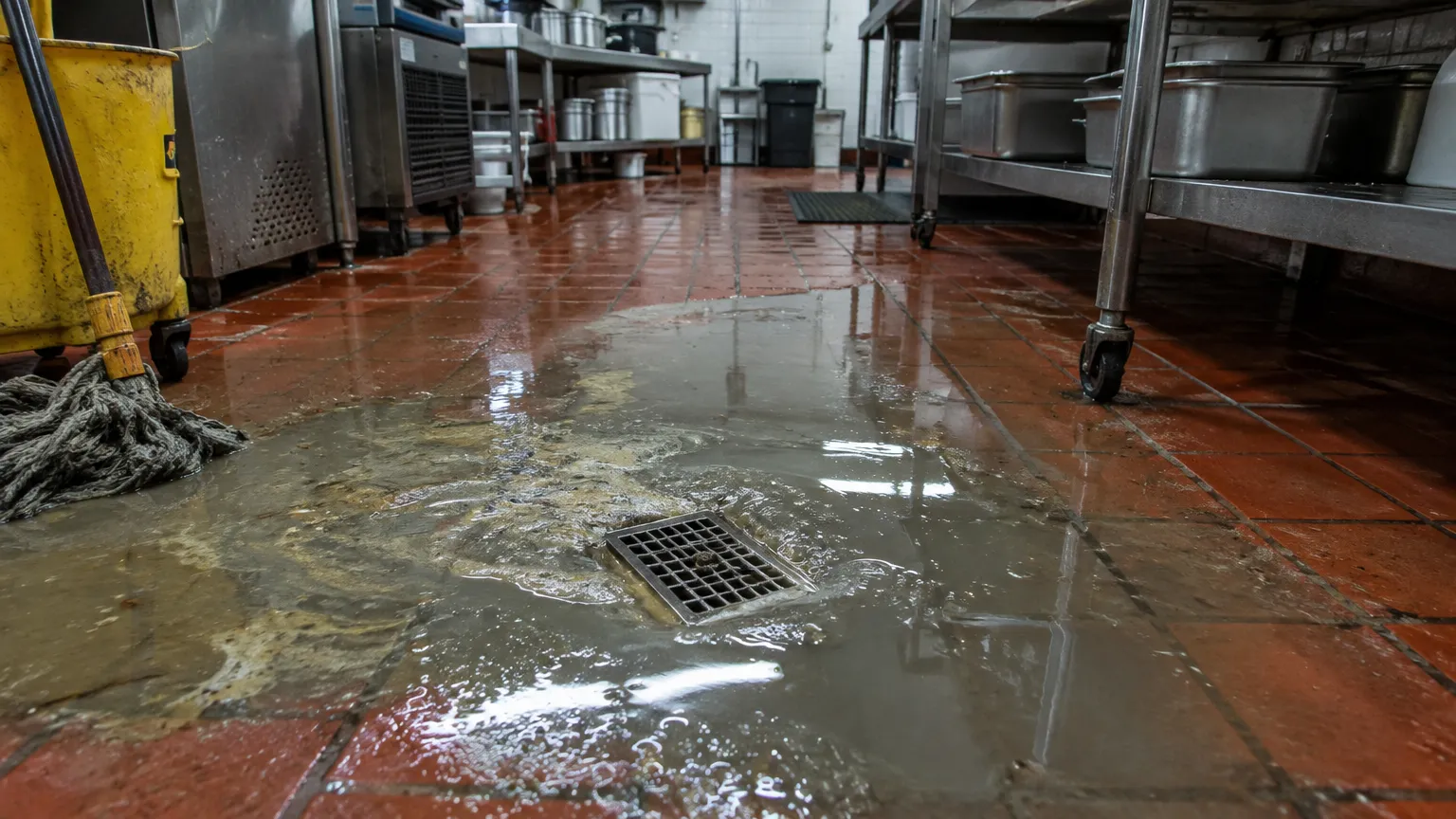
Floor drains that fill, bubble or gurgle
Austin Water explains that a blockage can push wastewater back out through a manhole, a cleanout or a drain into a home or business. In a kitchen, that can be a floor drain filling while the sinks and dishwasher run.
A sewer smell that returns after cleaning
If the floors and drains are clean and the smell is still there, the plumbing is the next place to look. Keep staff away from manholes and cleanouts while you find out: sewers are confined spaces that can hold hydrogen sulfide and methane.
Grease in the pipe after the grease trap
EPA’s August 2004 report to Congress named grease from restaurants, homes and industry as the most common cause of reported sewer blockages in the country. Houston Public Works puts it this way for its own system: “70% of sewer overflows in Houston are caused by clogs from fats, oils and grease poured down the drain and wipes flushed down toilets.”
If grease keeps building up in the line after your trap, check the trap too. A trap that is simply full needs your pumping company, not a repair. Cracked walls or a broken baffle (the inside wall that holds grease back) are damage, and that is repair work.
Calling for the line to be cleared again and again
Clearing a line with a high-pressure water jet or a cable machine removes the blockage. It does not close a crack, line up an offset joint or raise a sunken section. When the same line needs clearing over and over, a camera inspection is the way to see the cause.
The outdoor signs, such as wet ground or sinking pavement above the line, are on our trenchless pipe repair page.
What does a commercial sewer line camera inspection show?
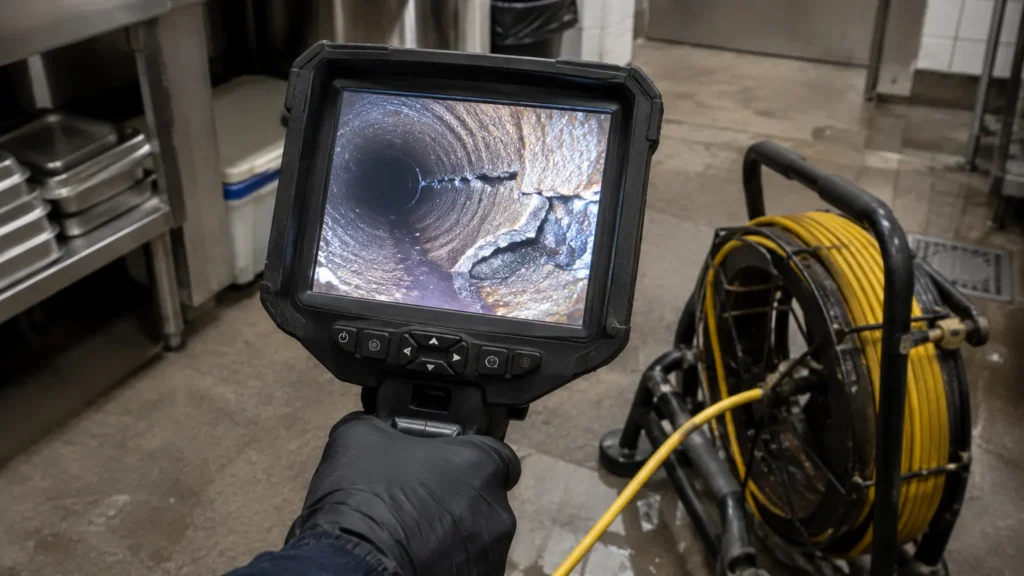
A camera inspection records video of the inside of the pipe. NASSCO, the sewer industry association, publishes a coding system for that video, called PACP.
Under PACP, each defect gets a grade from 1, the least serious, to 5, the most serious. The grade comes from the code the inspector records, not from opinion. A crack running along the pipe sits low on the scale. A broken pipe with soil or a void visible behind it sits at the top.
PACP keeps two kinds of grade apart:
- Structural defects, such as cracks, fractures and broken pipe. High structural grades usually call for an engineering look at the repair.
- Operation and maintenance defects, such as deposits and roots. These usually call for cleaning and root removal.
NASSCO also cautions that a grade on its own is not enough to decide whether a pipe should be repaired or replaced.
Can lining fix a belly in the line?
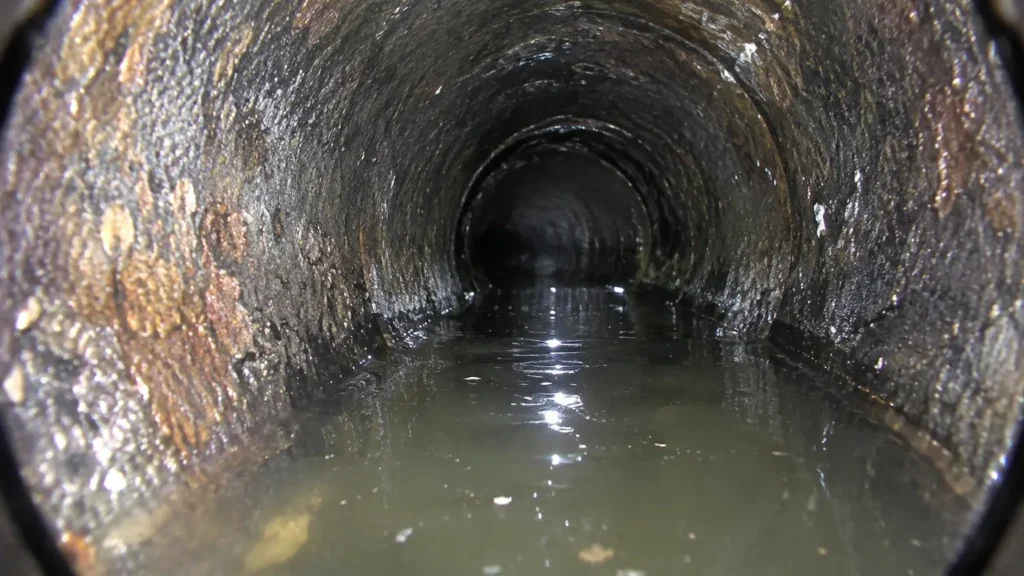
No. A belly, or sag, is a section of pipe that has sunk, so water and waste sit in the low spot instead of flowing on. A liner (cured-in-place pipe, or CIPP, a resin-soaked tube that hardens into a new pipe inside the old one) follows the shape of the pipe it sits in. Line a sag and you have a new pipe with the same low spot.
The clearest rules we found are from outside Texas, so read them for the technical point only:
- St. Paul, Minnesota fixes a bellied sewer service by digging, replacing it and correcting the slope. It allows lining through a belly only if the owner signs that lining will not fix it.
- Pinellas County, Florida approves lining a whole private sewer lateral only when it has no sags, deflections or offset joints.
EPA’s 1999 sheet on trenchless sewer rehabilitation adds a general caution, not one about bellies in particular: if a pipe’s alignment, slope or bedding has to change, each line has to be rehabilitated as a separate segment, which means even more digging. We found no Texas rule on lining over a sag. Ask your city before you plan the work.
Our trenchless repair is CIPP lining on 3 to 8 inch pipes. It suits cracked or weakened pipe that still runs at the right slope. If the camera shows a belly, lining is the wrong fix for that stretch.
Does a sewer line belly need to be replaced?
Usually, yes. The fix St. Paul, Minnesota describes is digging up the sunken section, replacing it and correcting the slope.
High water in the video is not always a sag: NASSCO notes that debris or extra flow can raise it too. A true sag is logged by where it starts, the water depth at its lowest point and where it ends.
What should you do first when the line backs up?
If sewage is coming up inside a restaurant or other food business, start there: Texas food rules can require you to stop operating, call your health authority, and get its approval before you reopen. Our guide to sewer line repair responsibility covers those steps, what to report to the city, and who pays.
Once it is safe to work on the line, clear it so the building can work again, then put a camera in it. Clearing alone tells you nothing about the cause. The video shows whether a crack, an offset joint, roots or a sag is behind the backup, and where along the line it sits.
Keep the video. Where the problem sits decides who pays for the repair, and the grade and type of defect shape which repair fits.
Who is responsible for sewer line repair in Texas
Questions
Is a sewer line camera inspection the same as a grease trap inspection?
No. A grease trap inspection looks at the trap. A sewer line camera inspection looks at the pipe that carries everything away from the building. Both can be failing at once.
Can a lined pipe still be cleaned?
Yes, but tell whoever cleans it that it is lined. A liner maker’s technical director, writing for NASSCO in 2019, calls routine water jetting acceptable and rules out cutting tools such as chain flails and root saws. The same tip warns that rodding machines can do a lot of damage to a liner’s surface, so the cable-machine clearing described above is not a safe default for a lined line. Our guide to how long CIPP lining lasts covers lined pipes in more detail.
How long does CIPP lining last
Do you work on homes?
No. Pipe InterTech works on commercial properties only.
Talk to us about your line
Pipe InterTech’s services are grease trap repair, trenchless pipe repair with CIPP lining, manhole rehab and coating, commercial plumbing and sewer camera inspection. We are open 24/7 at (833) 454-6464.
Sources
Austin Water, Sanitary Sewer Overflows
Houston Public Works, Wastewater Operations
- EPA, Report to Congress, EPA-833-R-04-001 (August 2004), as quoted in EPA fact sheet EPA-833-F-12-003 (2012)
NASSCO Tech Tips, June 2016 (PACP grades)
NASSCO Tech Tips, February 2019 (water level sags)
NASSCO Tech Tips, May 2019 (cleaning lined pipe, written by a liner maker)
NASSCO Tech Tips, July 2023 (structural and maintenance defects)
City of Saint Paul, Minnesota, CIPP Lining and Belly Acknowledgment Form
Pinellas County, Florida, Accepted Private Sewer Lateral Lining
- Texas Administrative Code, Title 25, § 228.1, which adopts the FDA Food Code 2017 (§ 8-404.11 and § 8-404.12)
Last updated: November 2026. By Pipe InterTech.