November 2026
Read a sewer camera report in three layers: the written log of what was found and where, the video that shows it, and the grades that rank each finding. The worst grade is a flag, not a verdict. A grade 4 or 5 tells you to look closer and decide a repair with the video in front of you. It is not an order to replace the pipe. Deposits are filed apart from cracks and breaks, and NASSCO ties them to cleaning rather than to an engineering assessment.
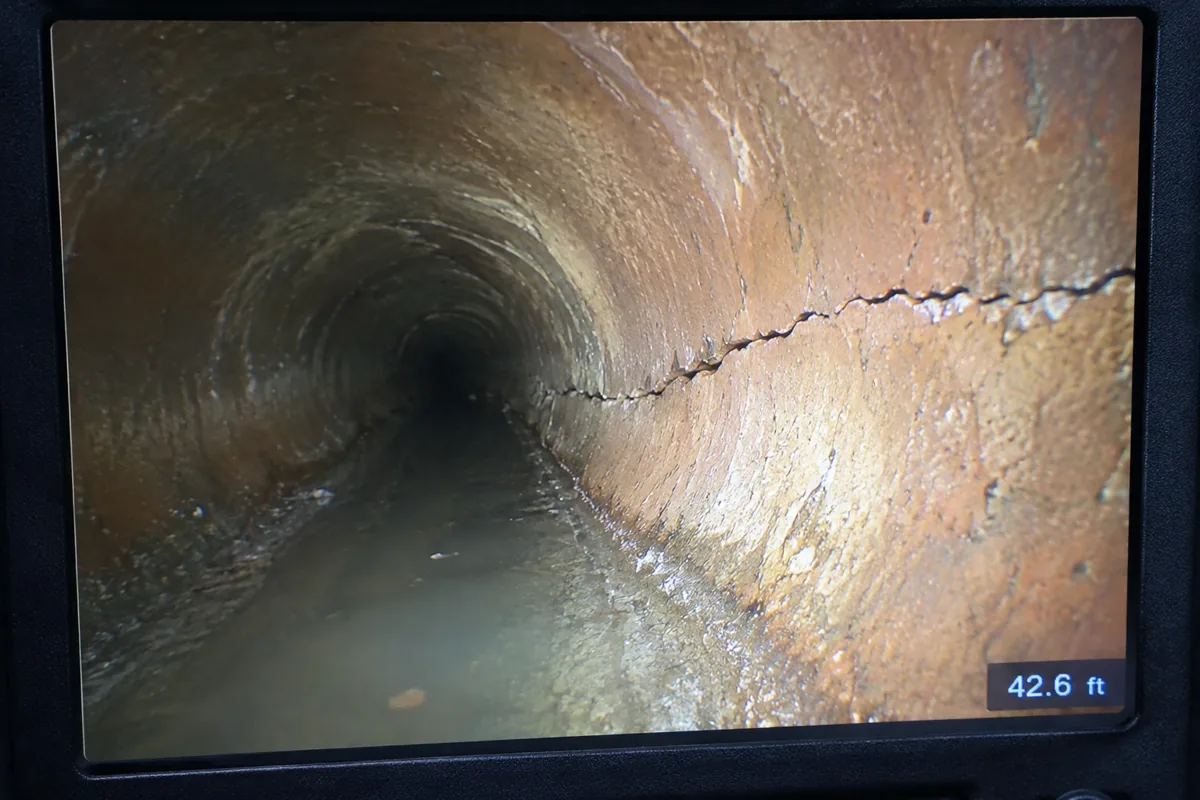
What is in a sewer camera inspection report, and what should you receive besides the PDF?
A good package has three parts that match each other: a written report, the video, and the coded data behind the report. Ask for all three.
The header
The header is the top of the report. NASSCO, the sewer industry association that publishes the PACP coding system for camera video, describes it as the place for general information about the inspection and the pipe segment, such as the inspection date and the reference numbers of the access points. A segment is the stretch of pipe between two access points. NASSCO-published guidance for contractors lists what identifies a segment: the upstream and downstream manhole numbers, a segment reference number, and the pipe’s size, material and length.
Check that the header describes your pipe. A wrong size, material or access point means the rest of the report may be about a different line.
The written log
The log is a list of findings. Each line gives a code for what the camera saw, how far along the pipe it was, and details such as a percentage or a clock position. For example, a CCTV project report from Los Angeles County, California, prints a line that reads “Crack Longitudinal” followed by a clock position. You do not need to memorize the codes. Ask the inspector to put any line you cannot follow into plain words.
The distance matters because it lets you find the spot again. Some public contracts spell this out. The City of Corpus Christi, Texas asks its own contractors for an on-screen distance from the starting manhole, accurate to 1 percent of the actual length. That figure comes from one city’s contract for its own lines. It is background on what a distance reading is meant to be.
The video
The video is the evidence; the log is somebody’s description of it. EPA’s guide for sewer systems says an advantage of camera inspection is that a permanent visual record is captured for later review. That is why you should keep the file. A second contractor can watch the same footage and tell you whether the log matches it.
The coded data export
PACP reports come from software, and NASSCO says the mandatory fields must be filled in per its data dictionary for the file to be a valid PACP deliverable. Ask whether you can have the data file as well as the PDF. A contractor who needs to line or repair the pipe can then work from the same coded findings.
How do you read the findings: the distance, the code and the grade?
Read one line at a time. Where along the pipe is it? What code is it? What grade did that code get? Then find that distance in the video and look.
A defect grade runs from 1 to 5
Every defect gets its own grade from 1, minor, to 5, most serious. The grade comes from the PACP manual based on the code and its details, not from the camera operator’s opinion. NASSCO’s example ladder: a longitudinal crack is a 2, a fracture a 3, a broken pipe a 4, and a broken pipe with soil or a void visible behind it a 5. Our guide to the signs of a failing commercial sewer line has the short version of PACP; this guide goes one step deeper.
Signs a commercial sewer line is failing
One log line, read step by step
Here is a real line from a published county CCTV report in Los Angeles County, California: “Crack Longitudinal, at 12 o’clock, within 8 inch”. Read it in three steps. (Ask the inspector what “within 8 inch” means on your pipe.)
- The code: “Crack Longitudinal” is a crack code, and cracks are structural findings.
- The details: the clock position and the other details recorded with the code. In PACP, those details help set the grade, and NASSCO’s quality guideline counts a wrong clock position or percentage as a coding error. Ask the inspector what the clock position means on your pipe.
- The grade: this county line does not print a grade. For comparison, NASSCO’s example ladder puts a longitudinal crack at 2, low on the scale; the grade on your own report comes from the code and its details.
Then find the same distance in the video and look at the crack yourself.
Structural and maintenance findings are separate
PACP codes fall into four families: Structural, Operation and Maintenance (O&M), Construction and Miscellaneous. The two that matter most to an owner are the first two. They are graded and reported separately. A crack or break is structural. A deposit is an O&M finding. NASSCO says O&M findings call for cleaning and similar upkeep, and that high structural grades usually call for an engineering assessment.
So look at the family before you look at the number: a deposit points to cleaning, while a high structural grade points to an engineering assessment.
The segment gets its own ratings
Besides the defect grades, a PACP report can give ratings for the whole segment. NASSCO describes eight or nine of them: Structural, O&M and Overall, each as a Quick Rating, a Pipe Rating and a Pipe Rating Index. NASSCO says the ratings come from the grades and how many times each grade is observed.
These are easy to misread, so here is what each one is:
- Quick Rating: a short code. NASSCO says it reports the worst grade seen in the segment and how many times that grade occurs. The first number is the worst grade. If you want to know what the other characters mean, ask the inspector to read them to you.
- Pipe Rating Index: the average grade in the segment, on the same 1 to 5 scale.
- Pipe Rating: a total, not a 1 to 5 number. In NASSCO’s example, nine grade-5 defects give a Pipe Rating of 45, and so do 45 grade-1 defects.
Averages and totals can hide the worst spot. NASSCO warns that six grade-1 defects and six grade-5 defects can sit behind the same index of 3. So do not rank your lines by one number. Look at the worst grade, how many there are, and the video.
What does a PACP grade tell you, and what does it not?
It tells you how a defect ranks on a common scale, which lets two contractors describe the same pipe the same way. It does not tell you what the repair is, what it costs or whether a city will act.
A grade 4 or 5 is not an automatic replace order
NASSCO says a condition grade alone is inadequate for deciding whether a pipe segment should be replaced. The decision also needs someone to look at the video and the pipe’s circumstances.
What we can say about repair options is general. Lining, which is cured-in-place pipe (CIPP), a resin-soaked tube that hardens into a new pipe inside the old one, is used on cracks, offset joints and weak sections, and EPA says it bonds to the old pipe. A liner follows the old pipe, so it does not correct a sag: a low stretch where water sits. That is a different repair, and our guide to signs of failure covers it.
What a Texas city asks of its own camera contractors
In our search (Texas state and city documents we could open), we found no Texas rule that requires PACP coding on a private commercial line. One Texas city’s contract does show what a careful inspection includes. The City of Corpus Christi’s spec for televising its own sewer lines (a city contract, not a rule for your building) asks for:
- an opening screen on each video with the upstream and downstream manhole numbers, the pipe size and material, the street names and the date;
- an on-screen distance from the starting manhole, accurate to 1 percent of the actual length;
- a camera speed of no more than 30 feet per minute, stopping where needed to record the condition;
- every observation recorded with PACP codes;
- two products: a narrated video and a software-made report cross-referenced to it;
- rejection of footage with camera distortion, poor lighting, a dirty or submerged lens, or blurry pictures (more on that below).
You can use the same list to judge the report you were handed.
A grade is not a legal threshold
PACP grades are a coding convention. A grade 5 on your report does not say a code was broken, and a low grade does not say you will pass an inspection. Do not quote a grade to anyone as proof of compliance in either direction.
A grade only covers what the camera could see
A grade covers what was seen. If the picture was poor, the log may be incomplete. NASSCO’s June 2013 Tech Tip on camera quality says the camera needs enough light for the pipe’s size and color, and that a good inspection shows the whole circumference of the pipe. It adds that heavy flow should be reduced or bypassed so the whole circumference can be seen. Use the Corpus Christi reject list above as a checklist when you watch your own video: can you see the whole pipe wall, or only part of it?
What does a restaurant’s report look like, and what changes with grease?
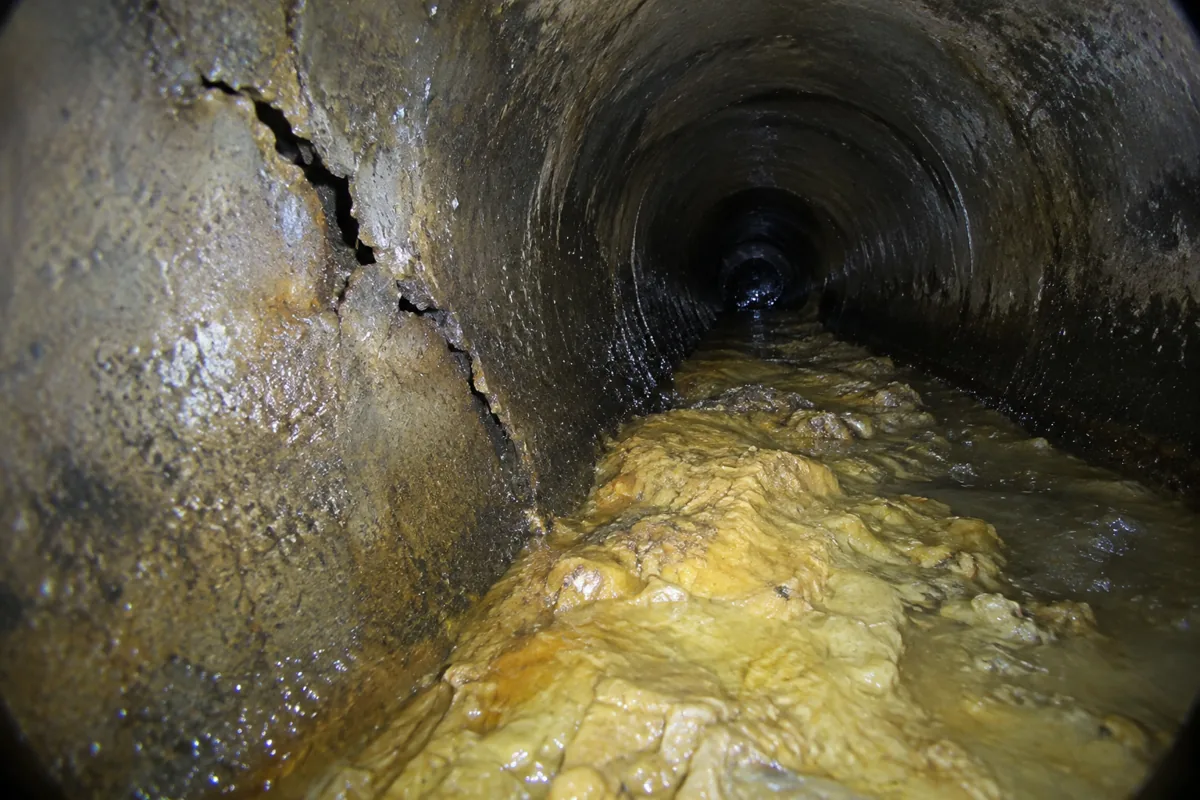
A restaurant’s report reads like any other, with one thing to watch: grease from the kitchen can show up in the line as deposits. Deposits are an O&M finding, and NASSCO ties O&M findings to cleaning and similar upkeep. Two things follow.
First, a heavy deposit can sit on top of the pipe wall you came to check. EPA says lines are cleaned and then inspected before lining, so ask for the line to be cleaned enough that the camera can see the wall, and for the cleaning to be noted in the report.
Second, a deposit on a clean-looking pipe is a clue about where it came from. If grease keeps returning after cleaning, the cause may be upstream, at the grease trap. That is a repair question, and we cover it in our guide to grease buildup after the trap.
Grease buildup in a commercial sewer line
Do not wait for a cleaning to read the structural part of the report. A crack does not wash away. If the log shows both, deal with the cause of the deposit and read the structural findings on their own.
What should you ask for when you order or receive a report?
Put these on the request before the camera goes in, or ask for them after.
- The video, in a file you can keep. Not only a clip or a few stills.
- The written log and the coded data. Ask for the data file as well as the PDF.
- A line that says where the camera stopped and why. If it could not reach the end of the pipe, the report should say so.
- A note on cleaning. Was the line cleaned first, and was anything left covering the pipe wall?
- A plain-words summary from the inspector. One page that says what needs a repair, what needs cleaning and what needs a second look.
Safety belongs in the request too. Do not open a manhole, cleanout or trap yourself to look at the pipe. EPA says camera inspection removes the hazards of confined space entry, which is one reason the camera exists. Leave the lid to the crew.
What happens after the report?
Match the next step to the finding.
- Deposits only: have the line cleaned, then watch for them returning. If they do, have the grease trap that feeds the line checked.
- Video unclear or incomplete: ask for the section to be cleaned and re-filmed.
- Cracks, offset joints or weak sections that still run at the right slope: lining may suit them; our trenchless repair lines 3 to 8 inch pipes. EPA lists these as defects lining can fix. Local rules can still exclude some (one Florida county, for example, will not approve lining a private lateral with sags or offset joints), and high structural grades call for an engineering assessment first.
- A sag, or a break with soil or a void behind it: an engineer or repair crew has to look at the video before anyone picks a method.
- After any repair: inspect again. EPA says the line is inspected before and after it is rehabilitated.
Who pays for work on the line under a building depends on where the damage sits and on the city. Our guide covers it.
Who is responsible for sewer line repair in Texas
Questions
What is PACP?
PACP is the coding system NASSCO publishes for sewer camera video. It sorts findings into four families of codes (Structural, Operation and Maintenance, Construction and Miscellaneous) and gives defects a grade from 1 to 5.
Is a grade 5 an order to replace the pipe?
No. NASSCO says a condition grade alone is inadequate for deciding whether a pipe segment should be replaced. A grade 5 is a reason to watch the video and decide a repair from what it shows.
Can a defect disappear after the line is jetted?
A deposit can. Deposits are O&M findings, and NASSCO says those call for cleaning. A crack or a break is structural and does not wash away.
Are manholes and laterals graded the same way?
Mostly. NASSCO has separate programs for laterals (LACP) and manholes (MACP). Laterals use the same pipe codes except the tap codes. Many pipe codes also apply to manhole parts, with changes, and manholes are coded on a separate form.
Do you work on homes?
No. Pipe InterTech works on commercial properties only.
Sources
NASSCO Tech Tips, Edition 84, July 2023 (PACP condition grading)
NASSCO Tech Tips, Edition 38, June 2016 (PACP condition grades)
NASSCO Tech Tips, Edition 19, June 2013 (CCTV quality)
NASSCO Tech Tips, February 2016 (what to log for each pipe)
NASSCO, Guideline for QA of PACP, LACP and MACP
NASSCO, 3-Day PACP/LACP/MACP 8.0 Course Syllabus
Updated November 2026
Talk to us about your report
If you have a camera report in hand and are not sure what it means for your line, call (833) 454-6464. We are open 24/7. Tell us what the report says, and we will tell you which of our services fits: grease trap repair, trenchless pipe repair, manhole rehab and coating, commercial plumbing or a camera look at the line.